
Texas Cottage Food Law (2026): What You Can Sell, Limits and Labels
At a glance
- License or permit
- None to produce or sell. No fee may be charged. Registration with DSHS is required only for TCS foods and for cottage food vendors, and is optional if you want an ID number on your labels instead of your home address.
- Annual sales limit
- $150,000 in gross sales, adjusted each year for inflation
- Allowed foods
- Any food except the prohibited list below, including baked goods, candy, jams, dry mixes, pickles and fermented vegetables, and (with registration) refrigerated items
- Not allowed
- Meat and poultry, seafood, ice and ice products, low-acid canned goods, products containing CBD or THC, raw milk and raw milk products
- Where you can sell
- Directly to consumers, including at farmers markets and farm stands, online with personal delivery, and (for non-TCS foods) wholesale to a registered cottage food vendor
- Training required
- Yes, an accredited food handler course
Who this law covers
A cottage food production operation (CFPO) makes food in a home kitchen. Individuals qualify, and so do nonprofit organizations, which may operate from the home of a director or officer. Cottage food operations are exempt from the Texas Food Establishment Rules.
What you can sell
Texas now allows any food unless it is on the prohibited list. Common examples include cookies, bread, cakes, candy, nuts, jams and jellies, granola, popcorn, dry mixes, pickled vegetables, roasted coffee and dried herbs.
Prohibited:
- Meat, meat products, poultry and poultry products
- Seafood, including fish and shellfish
- Ice and ice products, such as shaved ice, ice cream, frozen custard, popsicles and gelato
- Low-acid canned goods
- Products containing cannabidiol (CBD) or tetrahydrocannabinol (THC)
- Raw milk and raw milk products
Refrigerated foods (TCS foods)
Foods that need time and temperature control for safety, such as cheesecake or cream pies, may be sold, but you must register with DSHS through its Online Licensing Registry. Keep cold foods at 41°F or below and hot foods at 135°F or above. TCS foods cannot be donated or sold wholesale.
Pickled, fermented and acidified foods
Pickled fruits and vegetables, fermented vegetable products and plant-based acidified canned goods need a unique batch number on the label. Use a recipe from a DSHS-approved source, such as the USDA Complete Guide to Home Canning, or have the recipe approved by a qualified process authority. DSHS publishes lists of approved sources and accredited labs.
Sales limits and licensing
The annual gross income limit is $150,000, up from $50,000 before September 1, 2025. SB 541 also adjusts the figure each year for inflation (using the CPI-U index), so confirm the current amount with DSHS. Texas does not charge a fee or require a permit to produce, sell or give out samples. Local governments, including health departments, may not regulate how you produce cottage food or require a permit or fee. They also have no authority to inspect a cottage food operation, although DSHS or a local health authority can act through emergency or recall orders when there is an immediate and serious threat to health. Health departments keep a record of complaints.
You must register with DSHS if you:
- sell TCS foods, or
- act as a cottage food vendor (see below).
Registration is optional if you only want a DSHS-issued ID number to use on labels instead of your address.
Labeling requirements
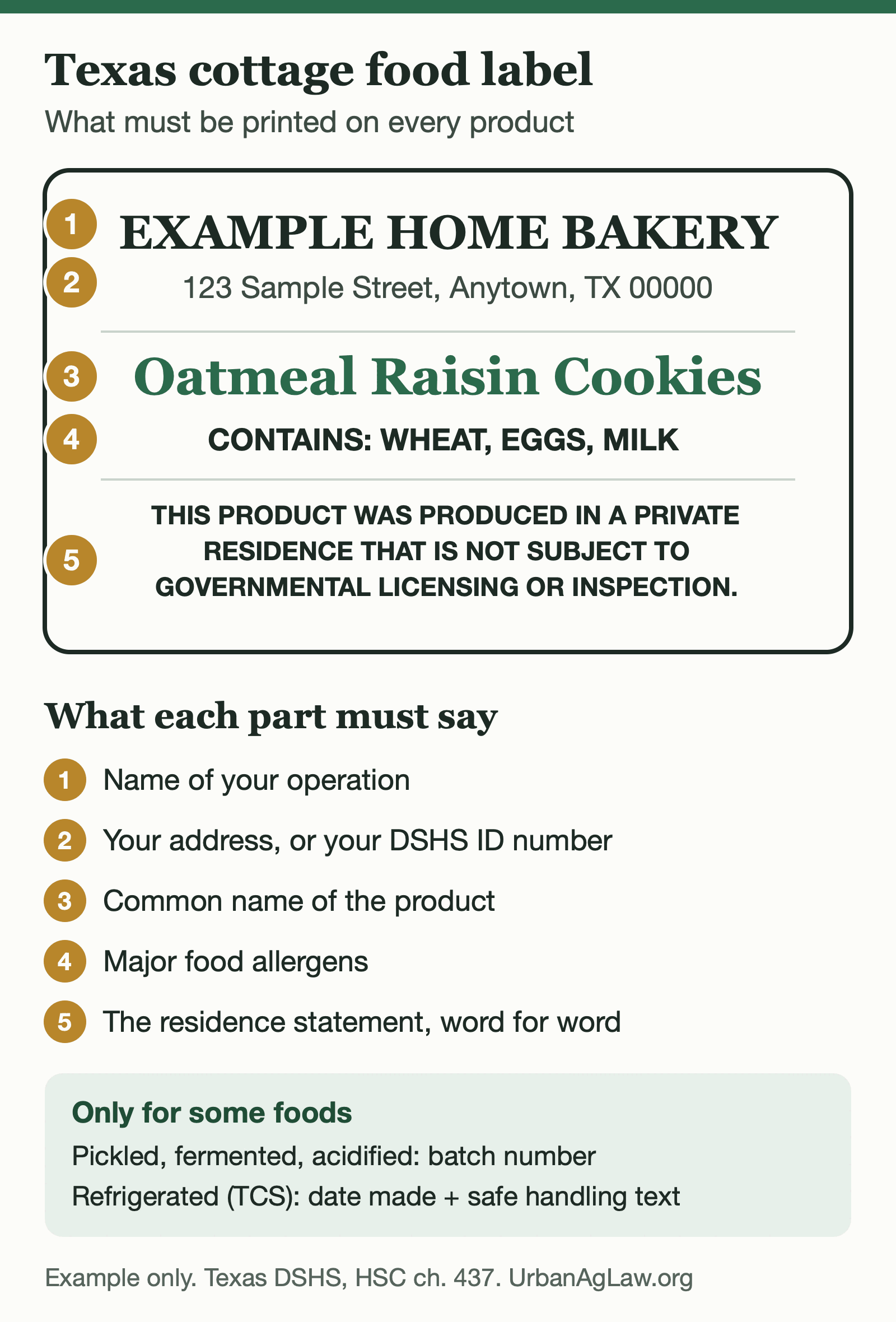
Labels must be legible and include:
- the name of your operation;
- your address, or your DSHS-issued ID number in place of the address;
- the common or usual name of the product;
- any major food allergens, such as eggs, tree nuts, soy, peanuts, milk, wheat and sesame;
- this statement: “THIS PRODUCT WAS PRODUCED IN A PRIVATE RESIDENCE THAT IS NOT SUBJECT TO GOVERNMENTAL LICENSING OR INSPECTION.”
Additional items apply in some cases: a batch number for pickled, fermented and acidified products, and for TCS foods a production date plus a safe handling statement in at least 12-point type (on the label or on the invoice or receipt). Food that is not packaged must carry the labeling information on an invoice or receipt.
Where you can sell
- Directly to consumers at farmers markets, farm stands, from your home, and at events. You may offer samples anywhere.
- Online: allowed if the customer buys from you directly, you (or an employee or member of your household) deliver the food in person, and the required label information is on your website before payment. Your address or ID number must appear on the label after payment. DSHS describes online sales only in terms of personal delivery.
- Through a cottage food vendor: non-TCS foods may be sold wholesale to a registered cottage food vendor, who resells them to consumers in Texas at a farmers market, farm stand, food service establishment or retail store. The vendor must be in Texas, be registered with DSHS, put the production date on the label and display the residence disclosure near the products.
- Donations: allowed, except for TCS foods.
Training and insurance
You must complete a basic food handler course accredited under Texas Health and Safety Code Chapter 438, Subchapter D. DSHS may accept a valid Food Manager Certification instead where applicable. Other people may handle your products only if they have this training, work under direct supervision of a trained person, or live in the household where the food is made. The cottage food rules do not require liability insurance, but many sellers carry product liability coverage, and some markets and retailers ask for it.
Local rules, HOAs and taxes
State law keeps cities, counties and health departments from regulating cottage food production or requiring permits. It does not remove private rules such as HOA covenants or lease terms, so read those if you rent or live in an HOA. We have not covered sales tax or business registration here. Check the Texas Comptroller and your city for those, and see our planning and zoning guide for general background on home businesses.
Frequently asked questions
Do I need a permit to sell baked goods from home in Texas?
No. Texas does not require a license or permit, and cities and counties may not require one or charge a fee. You still need to follow the labeling and food handler training rules.
Can I sell cheesecake or other refrigerated desserts?
Yes, since SB 541, if you register with DSHS, keep the food at safe temperatures and add a production date and safe handling statement to the label.
Can I ship cottage food to customers?
DSHS describes online sales as requiring personal delivery by you, an employee or a household member. Its guidance does not address mailing or shipping, so ask DSHS before shipping products.
Can I sell my products wholesale?
Non-TCS foods can be sold to a registered cottage food vendor. Direct wholesale to other businesses, and any wholesale of TCS foods, is not allowed.
Do I have to put my home address on the label?
Not if you register with DSHS. Registered operators can use the ID number DSHS issues in place of an address.
Note on conflicting sources
At the time of our review, the published text of the Texas Administrative Code rule on cottage food (25 TAC §229.661) still showed the earlier $50,000 limit and older label wording. The current DSHS guidance follows SB 541, which took effect September 1, 2025. Where they differ, follow the statute and DSHS and confirm with DSHS if you are unsure.
Official sources
- Texas DSHS: Texas Cottage Food Production (primary guidance for operators; email [email protected], phone 512-834-6753)
- Texas Health and Safety Code, Chapter 437
- Texas Senate Bill 541 (89th Legislature, 2025)
- 25 Texas Administrative Code §229.661